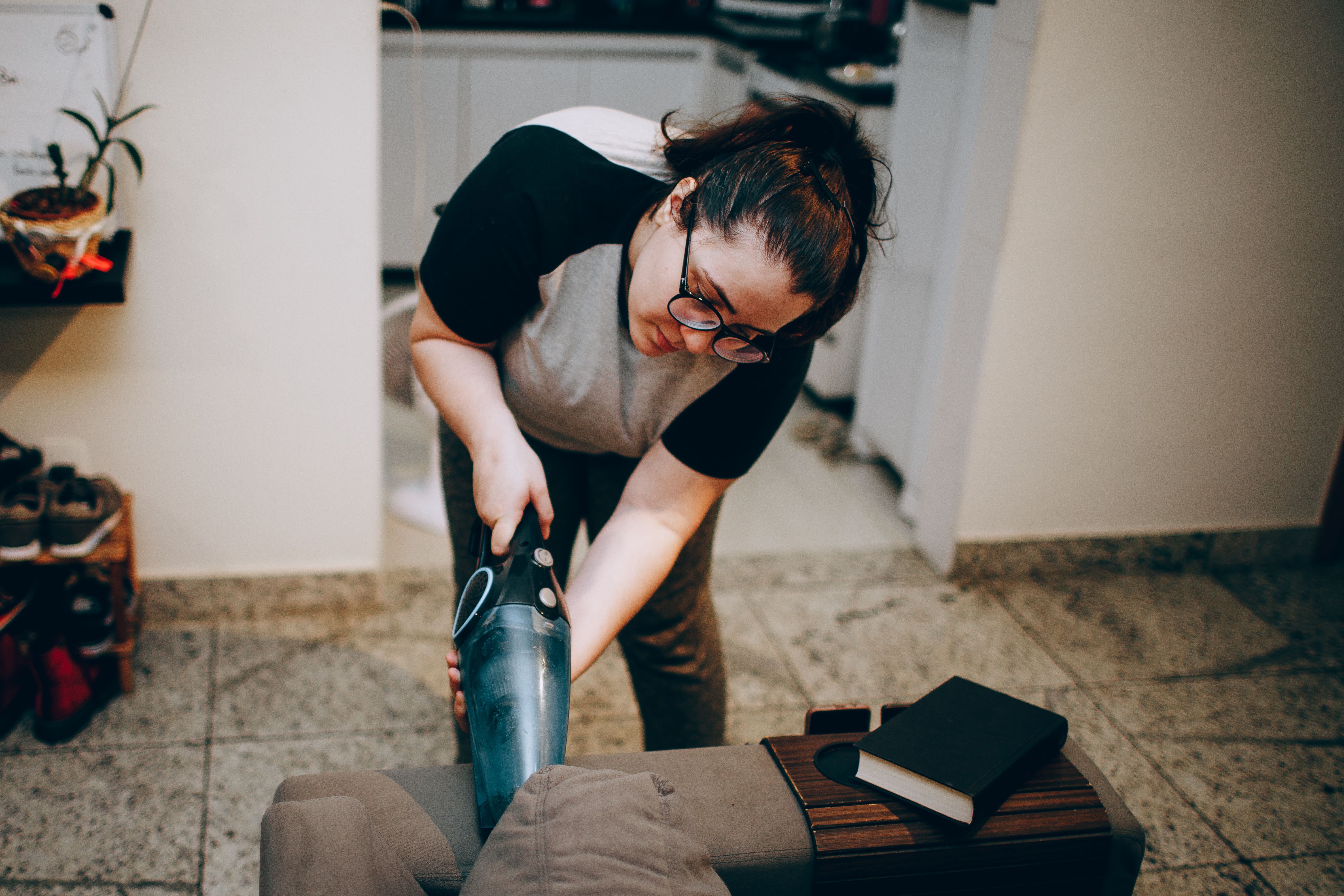
Cleaning with ADHD gets easier the moment you stop trying to force a neurotypical routine and start building a system that lives outside your head. Standard cleaning advice assumes steady focus, an accurate sense of time, and the ability to hold a plan in mind, which are the exact things ADHD makes harder. Work with your brain instead of against it, keep the tasks visible, and the whole thing stops feeling impossible. Here’s why it’s hard, the strategies that actually hold, and the app we’d start with.
Why cleaning with ADHD is different
Cleaning is an open-ended, low-urgency, multi-step task, which is close to the worst-case scenario for ADHD. A few patterns show up again and again:
Out of sight, out of mind. If a task or item leaves your view, it leaves your mind, so put-away piles and half-done jobs stop registering. We go deeper on this in our post on cleaning with ADHD and out of sight, out of mind.
Task paralysis. You look at a full room, can’t find step one, and freeze. More on that in why your house is messy with ADHD.
Time blindness. A ten-minute job feels like an hour, so you avoid starting.
Shame spiral. A messy home gets read as a character flaw, which drains the energy you’d use to fix it.
None of this is laziness, and none of it is a diagnosis. It’s a mismatch between how cleaning is usually taught and how an ADHD brain runs.
The one principle that ties it all together
Almost every ADHD cleaning tip is really the same move: get the system out of your head and into the world. Your working memory can’t be the place the plan lives, because that’s the part ADHD taxes most. So you externalize it. Make the task visible, make the reminder automatic, and make starting require as little decision-making as possible. Every strategy below is just a version of that.
Strategies that actually work
You don’t need all of these. Pick the two or three that click and build from there.
The problem | The move that helps |
|---|---|
The whole house feels like too much | Clean one micro-zone: a single surface, drawer, or corner |
You can’t tell how long it’ll take | Set a timer for 5 to 10 minutes and stop when it rings |
You can’t get started alone | Body double: clean on a call, or alongside a video or playlist |
Tasks disappear once out of view | Turn the mess into a visible task you can see and check off |
The routine lives in your memory | Use recurring reminders so it resurfaces on its own |
Hunting for supplies kills momentum | Keep one reusable set in each room where messes happen |
That last one is where a small sustainability choice pays off twice: reusable cloths and a refillable spray kept within reach beat stashing disposable wipes in every room, so you cut clutter and waste while removing the friction that stops you starting.
Where Plastnofy fits
This is the system-outside-your-head idea built into an app. You snap a photo of a mess, Plastnofy creates the chore, and it shows you a more sustainable way to clean it. The pile becomes a visible task instead of a vague dread, and setting the recurring ones once means reminders bring them back without you tracking anything. Most ADHD cleaning apps ask you to build the whole structure first (rooms, tasks, frequencies), and that setup is its own executive-function wall. Photographing a real mess skips it.
It works as a cleaning app for ADHD that turns the mess you’d forget into one clear thing to do, and it’s free to start. If you want a head-to-head of the options, we wrote a roundup of the best cleaning apps for ADHD, and for quick wins there’s our post on cleaning tips that actually work for ADHD brains.
Download Plastnofy free on the App Store and Google Play.
A weekly rhythm that survives a bad week
The goal isn’t a spotless home, it’s a system that still works when your focus is gone:
Do one visible zone a day, not the whole house.
Photograph messes as you notice them, so they become tasks instead of memories.
Put anything recurring on repeat so it comes back on its own.
Keep reusable supplies where you use them, so starting takes no setup.
On low days, shrink the task or body double instead of skipping entirely.
Common questions
Do people with ADHD struggle with cleaning?
Very often, yes, because cleaning demands the executive-function skills (starting, planning, sequencing, following through) that ADHD makes harder. It usually has nothing to do with effort or caring, the task just doesn’t stay on your radar long enough to finish.
How do I clean my house if I have ADHD?
Externalize the system. Pick one small zone instead of the whole house, set a short timer, turn messes into visible tasks, and let recurring reminders handle the repeating stuff so you’re not relying on memory. Small and visible beats big and remembered.
How do I clean when I have ADHD paralysis?
Shrink the first step until it’s almost too small to avoid, like clearing one surface or setting a five-minute timer. Body doubling helps too, since starting alongside someone lowers the barrier to beginning. The aim is momentum, not a finished house.
Is a messy house a sign of ADHD?
It can be one piece of the picture, but plenty of people are messy without ADHD and plenty with ADHD keep tidy homes with the right systems. This is lifestyle information, not a diagnosis, and only a qualified professional can assess ADHD.
The bottom line
Cleaning with ADHD isn’t about willpower, it’s about where your system lives. Keep it in your head and it collapses on the first bad day. Move it into the world, make the tasks visible, automate the reminders, and start with one small zone, and cleaning finally works with your brain instead of against it.